
Counseling and Mental Health Resources in Taiwan: You Have More Options Than You Know
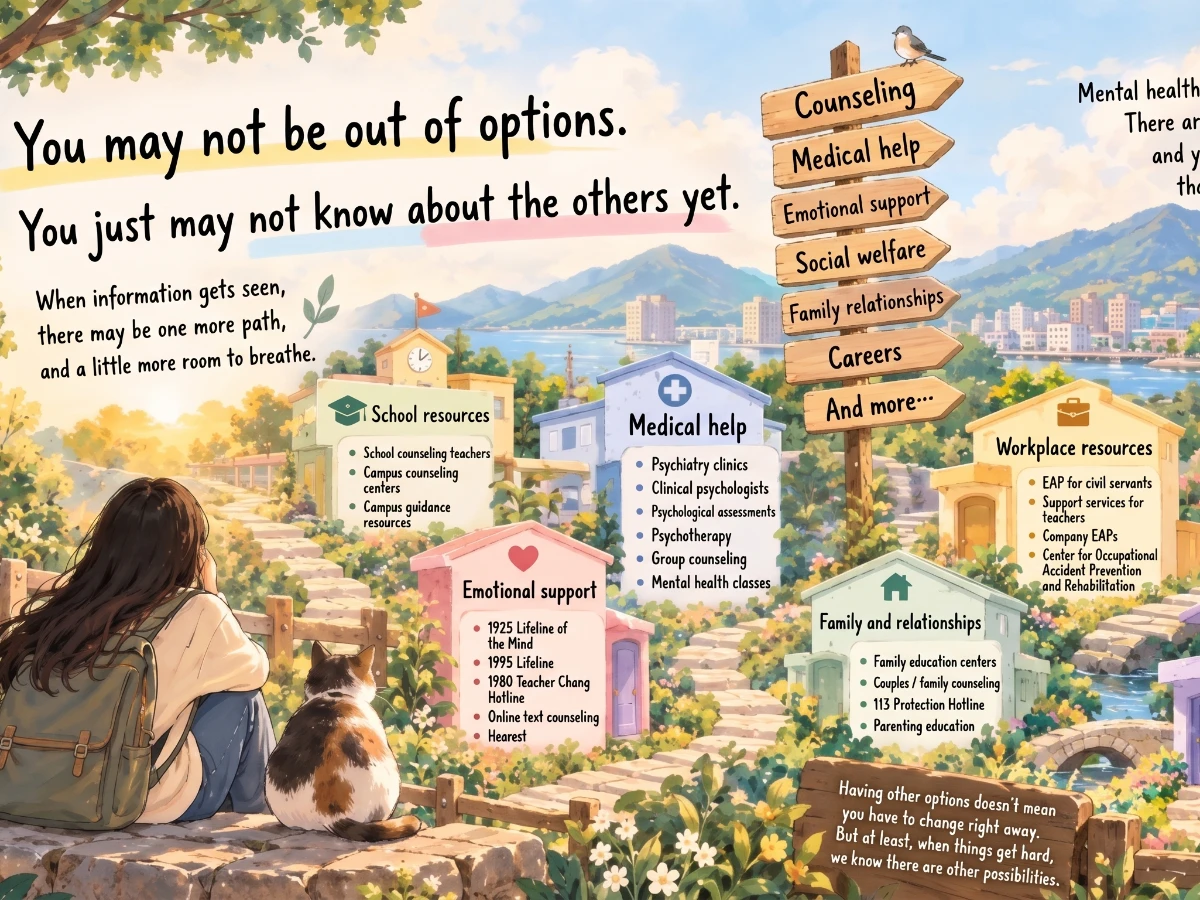
When someone stays stuck for a long time, sometimes it isn't that they don't want to change. They just don't know they have other choices. This letter rounds up the mental health services available in Taiwan: counseling you don't have to pay for yourself, options beyond counseling, lines to call when you just want to talk, and where to turn for help with specific life challenges.

Contents · 5 sections
A note from the Hearest team: Irene put this guide together for readers in Taiwan, so every service, hotline, and program below is in Taiwan. If you're somewhere else, the support lines at the bottom of this page are the ones for where you are right now.
In this letter
 In this letter
- The resources one person has come across aren't all the resources out there.
- Counseling doesn't have to mean paying for private sessions. Students, workers, and the general public all have options they can use.
- If a service you tried didn't help the way you hoped, that doesn't necessarily mean other approaches won't work.
- If you're not ready for a formal counseling relationship yet, calling a mental health support line can be a place to start.
- Knowing what's out there doesn't guarantee you'll get the help you need, but sharing information at least means you don't have to rely only on your own experience.
I've always felt that the free flow of information really matters.
Sometimes we assume that when someone stays stuck in the same place for a long time, it's because they don't want to change, don't want to ask for help, or have just gotten used to the way things are.
But I think there's another possibility:
They simply don't know they have other options.
For example, some people think counseling is always expensive. Some think you can only get psychological help if you've been diagnosed with a mental illness. Others think counseling is only for talking about emotions, and don't know there are other services, like couples counseling, family counseling, career counseling, and trauma therapy.
And some people have had counseling before, but because they didn't click with their therapist, they decided counseling just doesn't work for them.
Our understanding of mental health resources comes largely from the people around us, social media, and our own past experiences.
But the resources one person has come across aren't all the resources out there.
So I wanted to put together some of the mental health services available in Taiwan.
1. You want counseling, but you don't know where to start
Counseling doesn't have to mean booking a private practice and paying for it yourself. If money is a concern, here are some options:
| Students | Workers | Everyone |
|---|---|---|
| 1. Elementary, junior high and high school students can go to their school's counseling teacher, who decides, depending on the situation, whether to refer them or arrange sessions. 2. College and university students can go to their campus counseling center (depending on the school, you may wait a week or two for a first appointment). |
1. Civil servants: Contact the Employee Assistance Program (EAP) at your agency's personnel office, or at your city or county government's. 2. Teachers and school staff: Teacher support services in each city and county (eligibility varies from place to place, so check first) https://tcare.notion.site/tw-support 3. Private-sector employees: Counseling from the Center for Occupational Accident Prevention and Rehabilitation (up to 6 sessions per person per year) https://www.coapre.org.tw/tw/news-content/98d82cAe2D4a |
1. The government's mental health support program for adults aged 15 to 45 covers three free counseling sessions per person. 2. Mental health support programs at the community mental health center in each city and county 3. Psychiatry clinics (psychological assessment and counseling) |
2. What if counseling isn't right for you?
Counseling isn't the only form of mental health care.
For example:
- Psychiatry clinics: You can be seen through National Health Insurance, have your mood, sleep, anxiety, and other symptoms assessed, and talk through medication or other kinds of treatment.
- Clinical psychologists: They can provide psychological assessments, and treatment arranged around your needs.
- Group counseling: Through group interaction, you explore your relationships with other people and the experiences you share.
- Psychoeducation courses and support groups: Some hospitals, social service agencies, and community organizations run sessions on coping with emotions, adjusting to illness, support for caregivers, and more.
These services differ in purpose, in who provides them, and in when they're the right fit, and not every option suits everyone.
But if you've tried one service and it didn't help the way you hoped, that doesn't necessarily mean other approaches won't work.
3. If you're not ready for counseling and just want someone to talk to
Not everyone is ready to start a formal counseling relationship.
If right now you just need someone to listen, to talk through your feelings, or to help you make sense of what you're facing, you can call a mental health support line.
- 1925 Lifeline of the Mind: Free mental health support, 24 hours a day.
- 1995 Lifeline: Emotional support and help in a crisis.
- 1980 Teacher Chang Hotline: Counseling and support with life's difficulties; hours are posted by each local office.
- Teacher Chang online text counseling: Monday through Saturday, 6:30–9:30 p.m. https://www.1980.org.tw/service_item_show.php?service_item_id=1
For anyone who isn't sure yet what kind of help they need, these lines can be a place to start.
Besides professional support lines, you can also try online platforms for writing about how you feel or talking things through by text, such as Hearest, where you can sort out your feelings by writing or connect with other users. Keep in mind, though, that these platforms aren't the same as professional counseling or crisis services.
4. Mental health support for specific life challenges
| What you're facing | Where to go | What you can get |
|---|---|---|
| Family relationships, conflict between parents and children | Family education centers in each city and county; the 412-8185 Family Education Hotline | Advice on family relationships, parenting education, and referrals |
| Partner violence, control, or threats | 113; the domestic violence and sexual assault prevention center in each city and county | Safety assessment, protection services, and help from a social worker |
| Money worries, falling on hard times | The 1957 Welfare Hotline; social welfare service centers | Advice on welfare eligibility, information on emergency assistance, and referrals |
| Worn out from caring for an older relative | The 1966 Long-Term Care Hotline; family caregiver support centers | Long-term care assessments, information on respite care, and support for caregivers |
| Unemployment, feeling lost about your career | Taiwan Jobs; public employment service centers | Career advice, help finding work, and job training information |
| Losing a loved one, other major losses | Hospice and palliative care organizations, hospital social work departments, grief support groups | Grief support, and referrals to groups and mental health resources |
| Stress about gender identity or sexual orientation | Taiwan Tongzhi (LGBTQ+) Hotline Association and other LGBTQ+-friendly groups | Peer support, community resources, and referrals for mental health support |
| Bullying at school, students' mental health struggles | The school's counseling office, student counseling centers, the office of student affairs | Counseling on campus and professional referrals |
5. Common questions
| Question | The most direct first step |
|---|---|
| I want free counseling | Look into the program for adults aged 15 to 45 and your local community mental health center |
| I haven't been diagnosed with a mental illness. Can I still get counseling? | Yes. You don't need a diagnosis |
| I want treatment, but I don't know if I need medication | Make an appointment at a psychiatry clinic and let a doctor assess you |
| I've had counseling before, but that therapist wasn't right for me | Ask about switching therapists, or try another option |
| I want someone to talk to, but I don't want to start counseling | Call 1925, 1995, or 1980, or let it out on Hearest |
| I'm worried about a family member's mental health, but they won't see a doctor | Ask your community mental health center about support for families |
| Caring for a family member long-term is wearing me down | Call the Family Caregiver Hotline at 0800-507-272 |
| A family member or partner is threatening me with violence | Call 113. If you're in immediate danger, call 110 |
These hotlines and services can change at any time, so please check the official websites for current rules and eligibility. If anything here differs from what they say, the official information takes precedence.
Some resources have been there all along. We just don't always know where to look.
Of course, knowing what's out there doesn't mean you'll be able to get help easily. Cost, waiting times, eligibility, and the uneven spread of services can still be real barriers.
But I think the free flow of information at least means that when people face a problem, they don't have to rely entirely on their own past experience, or on what a few people around them say.
If you know of other free, low-cost, or lesser-known mental health resources, please write in and share them.
I hope this list can keep growing, so that people who need it can more easily find information that's right for them.
Written by
Irene Chang
TownTown · Peace of Mind & Communication Mentor
Irene holds an M.S. in Thanatology from National Taipei University of Nursing and Health Sciences and a B.A. in History from the College of Humanities and Social Sciences at National Dong Hwa University. Having lived through deep personal trauma and night after night of sorrow, and having stood beside people sinking into emotional quicksand, Irene followed an inner calling and picked up the microphone, hoping that sharing this experience might light a small glow in other people's hearts. Irene's academic work focuses on depression. Irene has hosted more than 20 healing talks at universities and foundations, helping people living with depression, and the people who support them, find better ways to communicate and to cope with their emotions.
See all letters from Irene Chang