
From Physical Hunger to Emotional Hunger: What's Really Behind the Urge to Eat, and How to Break the Cycle
You're not hungry, but you can't stop wanting to eat. This letter looks at why physical and emotional hunger so often show up together, how stress and cortisol turn up cravings, and why learning to read your body's signals again helps more than strictly banning certain foods.

Contents · 6 sections
In this letter
 In this letter
- Physical hunger and emotional hunger often show up together. We just rarely stop to tell them apart.
- Stress keeps cortisol running high, and cravings for sugary, fatty foods get stronger with it.
- Strict dieting tends to make emotional eating worse, and blaming yourself usually only makes things harder.
- The point isn't to ban certain foods. It's to relearn how to read your body's real signals.
- Pause for three seconds and ask yourself: Is it food I need right now, or rest, or comfort?
It's ten at night, and you're standing at the fridge, suddenly craving something sweet or fried. You've been busy all day and you're not really hungry, but one particular food keeps popping into your head. Maybe it's dessert, maybe something fried, or maybe just a taste you know well.
You tell yourself you'll skip it today, but you still end up at the fridge, or opening a food delivery app, or grabbing the snacks on the table. The moment you take a bite, something in you seems to loosen a little. Then, a little later, the self-blame shows up: Why did I eat again? I wasn't even hungry, so why couldn't I stop? Starting tomorrow, I'm getting this under control.
It's easy to come away from this feeling like you just don't have enough willpower. But it's usually not that simple.
Physical hunger and emotional hunger often show up together
Sometimes you really are hungry. Other times, after a whole day of being busy and worn out, part of you is looking for something quick and familiar that will comfort you. These two needs aren't necessarily either/or. A lot of the time they happen at once; we just rarely stop to tell them apart.
Emotional eating involves more than you might think: stress, tiredness, loneliness, feeling wronged, boredom, going a long time without a break, and the comfort that food has brought you before. Research has found links between emotional eating and being overweight, depression, anxiety, and stress. When people are under a lot of stress or feeling low, they tend to eat more high-calorie sweet and fried foods.
Why stress makes us want to eat
When stress hits, the hypothalamus in your brain sets off the release of cortisol. Besides keeping you alert, cortisol also affects your appetite. If you're under heavy stress for a long time, cortisol stays high, and that noticeably increases cravings for foods high in sugar, fat, and salt. These foods are especially tempting because they activate the brain's reward circuits and release dopamine, which brings a brief but real sense of relief.
Not getting enough sleep makes this cycle even worse. When stress disrupts your sleep, two hormones that regulate appetite, ghrelin and leptin, get thrown out of balance. That makes you hungrier during the day, and makes it harder to tell whether your body actually needs energy or your emotions are looking for a way out. If you can't tell whether you're hungry or tired, it may really not be in your head. It may be your hormones acting up.
Lab studies have confirmed the link: when participants were put in stressful situations, their cortisol levels rose, and the people with the strongest cortisol response also had the strongest cravings for high-calorie food, and ate more of it. Not everyone is equally prone to stress-driven cravings, either. Research has found that people who already see themselves as "stress eaters" not only have stronger food cravings overall, but in the moment they actually feel stressed, those cravings get even stronger.
A cycle that keeps repeating
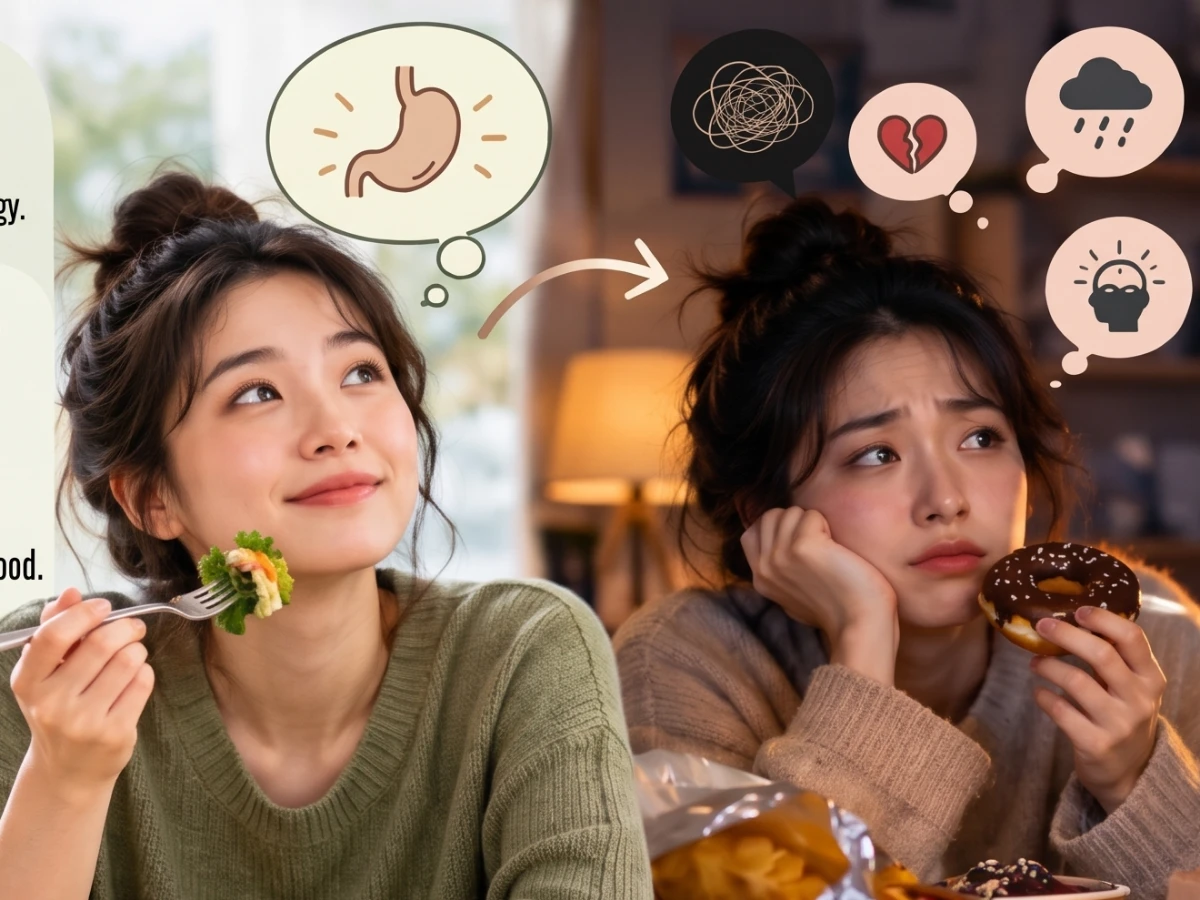
Emotional eating often gets stuck in the same loop. First a feeling comes up. Then you start wanting to eat something. You eat it, and you really do feel a bit better for a moment. But the self-blame soon follows, the stress gets worse instead of better, and you're back where you started.
The relief food brings is real, and that's exactly why your brain remembers it so well. The next time a similar stress or feeling comes along, that familiar food naturally becomes the first way out you think of.
The point of understanding this cycle was never to beat yourself up for doing it again. It's to help you bring your attention back to what actually just happened.
Blaming yourself usually only makes it worse
When people face this cycle, their first reaction is often to tighten their self-control and promise themselves that tomorrow they'll cut certain foods out. But research shows that strict dieting can actually make emotional eating worse. Holding back for a long time disconnects you from your body's natural hunger and fullness signals, so when stress hits, the urge to eat is even harder to resist. Then you blame yourself for slipping, and the vicious cycle starts again.
That's why, in recent years, the field of nutrition has been paying more and more attention to approaches like mindful eating and intuitive eating. At their heart, they're not about banning certain foods. They're about relearning how to read your body's real signals.
Mindful eating trains you to "feel," not to "forbid"
Literature reviews have found that mindfulness-based interventions work especially well for binge eating, emotional eating, and eating triggered by outside cues. These approaches don't ask you to control every bite. The point is to bring your attention back to your body.
Another review found that people who eat more intuitively tend to have better-quality diets, less emotional eating and bingeing, and more positive self-acceptance and body image. These interventions worked most reliably when they were delivered in person and in groups, and lasted at least three months.
In other words, learning to recognize "Is it food I need right now, or rest, or comfort?" is a skill in its own right, one that research supports and that's worth practicing.
Some things you can try
The next time you're standing at the fridge, try pausing for three seconds and asking yourself: Is it food I need right now, or rest, or comfort? Halfway through eating, you can ask one more question: Am I satisfied now?
You don't have to forbid yourself from eating, and you don't have to eat every bite perfectly. The point is to bring your attention back to yourself. If you really want it, then eat it properly: put a portion on a plate, sit down at the table, put your phone away, and give the first three bites your full attention. Then ask yourself whether you want more or you've had enough.
You can also try noticing three things: When did today's stress start building up? What do I want most right now: food, a chance to relax, company, or just a break from thinking? Which part of the cycle am I stuck in at the moment?
You don't have to manage to stop every time, and you don't have to prove yourself with a perfect performance. Once you can see the path this reaction takes, you have a chance to give yourself one new option at one of its steps. And there's no need to blame yourself after you eat. Next time, just try to understand yourself a little better than this time: When do I usually reach for food to comfort myself? Tell yourself, gently, that it's okay to take it slowly and keep practicing.
If your eating often feels clearly out of control, if you feel intense distress after eating, or if this is already affecting your daily life, please reach out to a dietitian, a mental health professional, or a doctor. This letter is general health education and can't replace an individual assessment.
Written by
Vera Lin
Wujing Health · Mind-Body Awareness Guide · Founder · Clinical Dietitian (Taiwan)
Working on the front lines of health care, I saw how many people were struggling with binge eating, burnout, and anxiety, and how often a restless heart lay underneath. So I founded Wujing, bringing together evidence-based nutrition, mindful eating, and herbal care. I've walked alongside people through more than a thousand sessions, and I'd love to keep you company over a cup of tea and a few slow breaths, as you let go of the tension and find the courage to accept yourself again.
See all letters from Vera Lin