The Hardest Part of a Master's Degree Isn't Actually the Thesis
Finding money, commuting, writing a thesis, running events. Looking back, what took up most of my energy during my master's wasn't entirely the studying itself. This letter is about how money worries turn into a sense of scarcity, why the free time each of us has isn't the same, and what a degree really leaves you with.
Contents · 7 sections
In this letter
 In this letter
- Being poor isn't just a financial situation. It's a feeling of scarcity, and it quietly seeps into the way you see yourself and other people.
- Everyone gets the same twenty-four hours a day, but the time each of us actually has free to use isn't the same.
- A thesis isn't a paper you can turn in after one late night. Ask yourself first: What am I actually willing to spend this much time writing about?
- Researchers don't always stand outside their research. When you write a self-narrative study, you yourself are part of the field.
- Whether someone finishes a degree isn't only about how hard they try. It also depends on money, time, energy, where they live, their support system, and the professors they end up with.
If I had to sum up what I actually did during my master's, it would come down to four things:
Finding money, commuting, writing my thesis, and running events.
Looking back now, what really took up so much of my energy in those years wasn't entirely "studying" itself.
1. Finding money
Money worries are truly agonizing, especially when you don't have much of a safety net.
First, I had to take out student loans for tuition. Then, every month, I was wondering where next month's living expenses would come from. It really felt like a huge mountain sitting on top of me.
Over time, I realized that poverty isn't just a financial state. It's also a feeling of scarcity.
It can even slowly turn into a sense of inferiority. Like a fine rain, it soaks silently into every part of your life, and into the way you see yourself and other people.
Some days, it felt less like doing a master's and more like playing a survival game.
Except this survival game was very real, and there wasn't much room to lose, because tuition, transportation, living costs, even your next meal, don't pause just because you're still a student.
Even when I had enough money to get by for three months, I still couldn't help feeling anxious.
What about after those three months?
It's the feeling of being safe for now, while your body is still stuck in crisis mode.
To finish this degree, I worked part-time on and off, and at one point I even held a full-time job while studying.
I also spent a lot of time hunting for scholarships, grants, and all kinds of financial aid.
Some people might think these things just come easily to me, but those skills were really shaped by one survival crisis after another.
If I'd had the choice, of course I'd rather not have become so good at finding resources out of fear of not making it.
That's something I came to feel very deeply:
We tend to chalk "finishing a degree" up to how hard someone works. But a lot of the time, whether a person can really study also depends on whether they have money, time, a place to live, and someone around who can catch them when they fall.
Some people are doing a master's.
Others are doing a master's while trying to survive.
2. Commuting
The university was really far from home, so a round trip took me about four hours.
Of course, some classmates lived even farther away than I did. But for me, the biggest problem was that my stamina is really low.
How low?
Ever since elementary school, I've been the kid who came in last in every race. Even classmates who weighed more than me ran faster than I did.
So every time I got home from the commute, my whole body would ache, and I'd just crash and sleep.
Commuting long-term really wears you down.
On the surface, it looks like you're just sitting there scrolling on your phone, but your brain is actually juggling a lot of small, scattered pieces of information.
Checking schedules, worrying about missing the bus, wondering whether the freeway would be backed up, whether I needed to add money to my phone, which way of paying for the metro earned more cash back, and how to get the cheapest intercity bus fare…
Each of these things is tiny on its own, but when they repeat week after week, they become a constant drain.
Of course, I did try living in the dorms.
The graduate dorm was a new building with double rooms, and honestly, it was pretty nice.
But the dorm didn't allow cats, and I worried about my cat at home, so I still had to go back often. And I couldn't get used to the hard bed boards. Even after I bought a separate mattress, I still slept badly.
On top of that, because the building was new, housing wasn't cheap either.
So in the end, I went back to commuting.
That experience taught me something I've understood ever since:
Everyone gets the same twenty-four hours a day, but the time each of us actually has free to use isn't the same.
Some people can be back in their room ten minutes after class. Others are only just starting a two-hour trip home.
So sometimes, when we see someone who's "inefficient" or "slow to get things done," it may simply be that their time costs more than other people's to begin with.
3. Writing my thesis
1. Choosing a topic
I'd come up with more than ten possible topics, so I spent a long time thinking about what I actually wanted to write.
Or, more precisely:
What am I actually willing to spend this much time writing about?
After all, a thesis isn't a paper you can turn in after one late night. If you don't even want to know the answer to your own question, writing it is probably going to be miserable.
2. Finding an advisor
Because my topic was still up in the air, I didn't look for an advisor for my entire first year.
It wasn't until my second year, as if I'd only just caught on, that I started looking for the right advisor.
But by then, the professors I'd originally leaned toward were almost all full, so I started reaching out to some I didn't know very well.
After asking around, feeling things out, and talking with about five professors, I finally had an advisor.
Besides their field, research topics, and methods, I later realized that what I really cared about was whether our ways of working fit.
On that front, I'm very grateful to my advisor for giving me so much room to work my own way.
3. Figuring out how a thesis is actually written
My undergraduate project wasn't a thesis, and I'd never written a research paper before, so at first I honestly had no idea what a thesis was supposed to look like.
For a while, I kept going to the library and carrying home every research methods book I could find.
Then I followed what the books said and stumbled my way through.
I also asked AI to play a very strict advisor and help me figure out what was wrong and what needed changing.
After revising it more than a dozen times on my own, I finally felt like, "Okay, maybe this is good enough to show people," and only then did I present my proposal.
Then, at my proposal defense, the committee overturned more than half of it.
So I had to go back.
Rebuild the structure, reorganize the content, and rethink what I was actually writing about.
That was a really long stretch of time.
Countless late nights, and when I wasn't restructuring the thesis, I was fighting with the formatting in Word.
I'd never known Word could be so hard.
Page numbers, section breaks, heading levels, the table of contents, figures and tables, formatting…
I watched tutorial video after tutorial video and kept asking AI until I slowly got it right.
It's all knowledge of the "nobody teaches you this, but you have to figure it out yourself" kind.
And because I was writing a self-narrative study, there was another layer to it.
I had to keep going back to my own life experiences, and that material isn't something you can just "finish analyzing" and be done with.
Sometimes, in the middle of writing, my trauma responses would come up too.
So while I was writing my thesis, I needed ongoing counseling, and I had to keep an eye on my emotional state, to stay in a place where I could "keep writing without getting swallowed up by what I was writing."
That was a whole different kind of difficulty.
Not something I can really explain to anyone who hasn't been there.
It was only then that I really felt that a researcher doesn't always stand outside the research.
At least for me, I myself was part of the field I was studying.
4. Running events
With the help of a grant and the support of the people I worked with, I ran three community events during my master's.
The first was a storytelling event where older people shared their life stories.
The second was an herbal tea workshop for body and mind.
The third was a picture-book event for grandparents and grandchildren.
Each time, I wanted to try something different, and I brought in partners from different fields to make it happen.
From planning and pitching to coordinating, running the event, and writing up the final report, I honestly enjoyed the whole process.
Unlike the thesis, running an event gives you a very direct feeling.
Something that started as an idea in my head became a plan. Then I found resources, found people, and talked it through, and one day it actually happened.
People showed up.
The event began.
Something that hadn't existed before was real now, because we'd made it.
I loved that feeling.
It showed me that I actually have it in me to take something from zero to one.
And that feeling can give you a lot of strength.
Honestly, a lot of the time, I didn't feel like a good student.
Especially since I can slip into a low very easily.
When I'm in a bad place, I really can't do anything.
If you asked me, "After finishing your master's, do you feel like you learned a lot of professional knowledge?"
Honestly, "a lot" isn't what I'd say.
Of course, I still came across a lot I'd never encountered before, like different kinds of complementary therapies, and I slowly built up some research and writing skills.
But looking back now, I think what this master's really left me with might not be the knowledge from any particular subject.
It's more like this:
I started trying to be a bit more tactful in how I deal with people, and I got to see fields I'd never been exposed to before. I learned to find resources and methods on my own, to pitch ideas, do research, and solve problems, and I slowly figured out what kind of working style suits me.
I used to think that finishing a degree would come with a feeling of "Look how capable I've become."
But when I actually finished, it didn't.
It felt more like I'd dealt with a huge pile of things.
Some I handled well, some I made a mess of. Some I did on my own, some with other people's help. Sometimes I had lots of energy, and sometimes I was just barely keeping things running.
Then, one day, I looked back and realized:
Oh. I actually made it to the end.
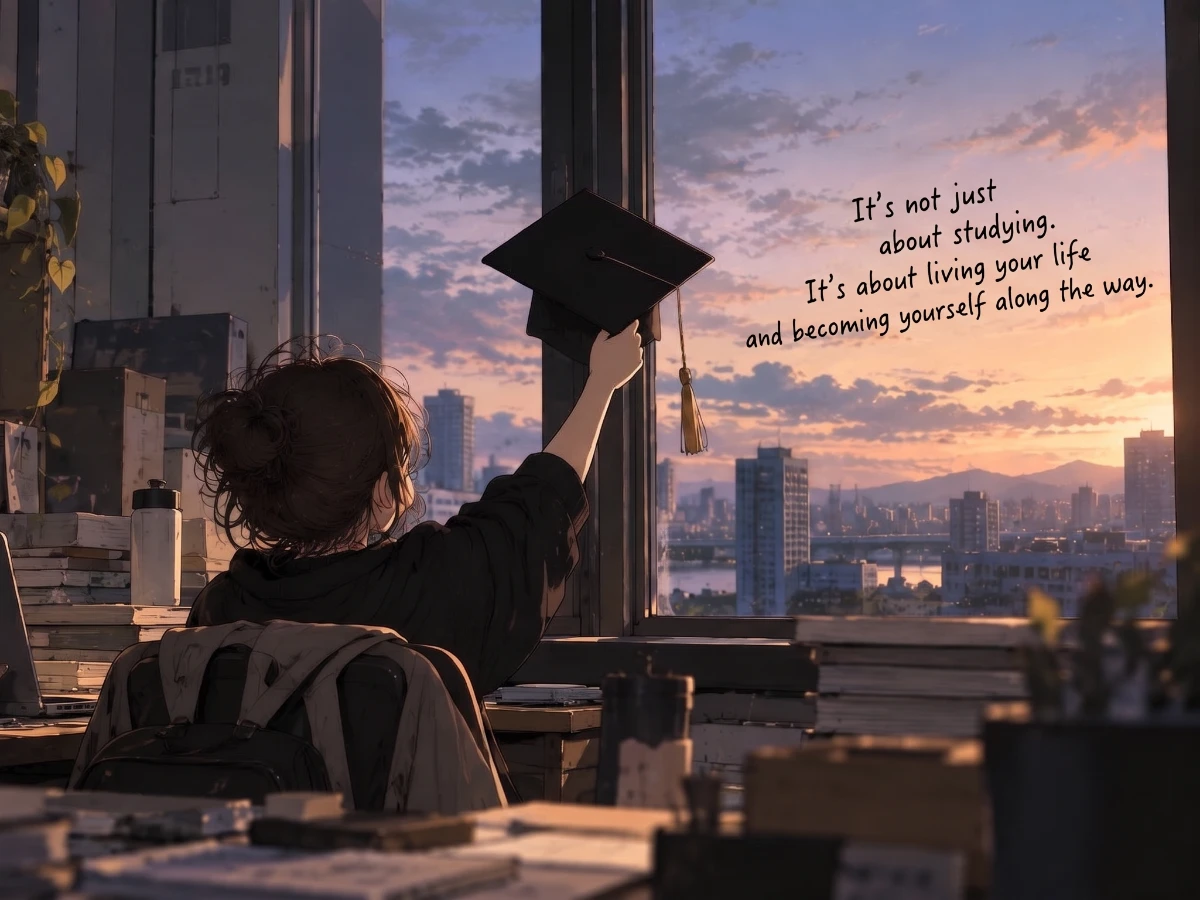
Looking back now, I think whether someone finishes a degree really isn't as simple as whether they're "working hard enough" or not.
It also has to do with money, time, energy, where you live, your support system, the professors you end up with, and even a lot of tiny administrative hassles.
So if you asked me what I actually did during my master's —
Maybe it wasn't just finishing a thesis.
It was, in circumstances that were often far from perfect, finding ways to keep my life going while learning to do research, to work, and to collaborate with others, and every now and then, turning something that had only existed in my head into something real.
Written by
Irene Chang
TownTown · Peace of Mind & Communication Mentor
Irene holds an M.S. in Thanatology from National Taipei University of Nursing and Health Sciences and a B.A. in History from the College of Humanities and Social Sciences at National Dong Hwa University. Having lived through deep personal trauma and night after night of sorrow, and having stood beside people sinking into emotional quicksand, Irene followed an inner calling and picked up the microphone, hoping that sharing this experience might light a small glow in other people's hearts. Irene's academic work focuses on depression. Irene has hosted more than 20 healing talks at universities and foundations, helping people living with depression, and the people who support them, find better ways to communicate and to cope with their emotions.
See all letters from Irene Chang